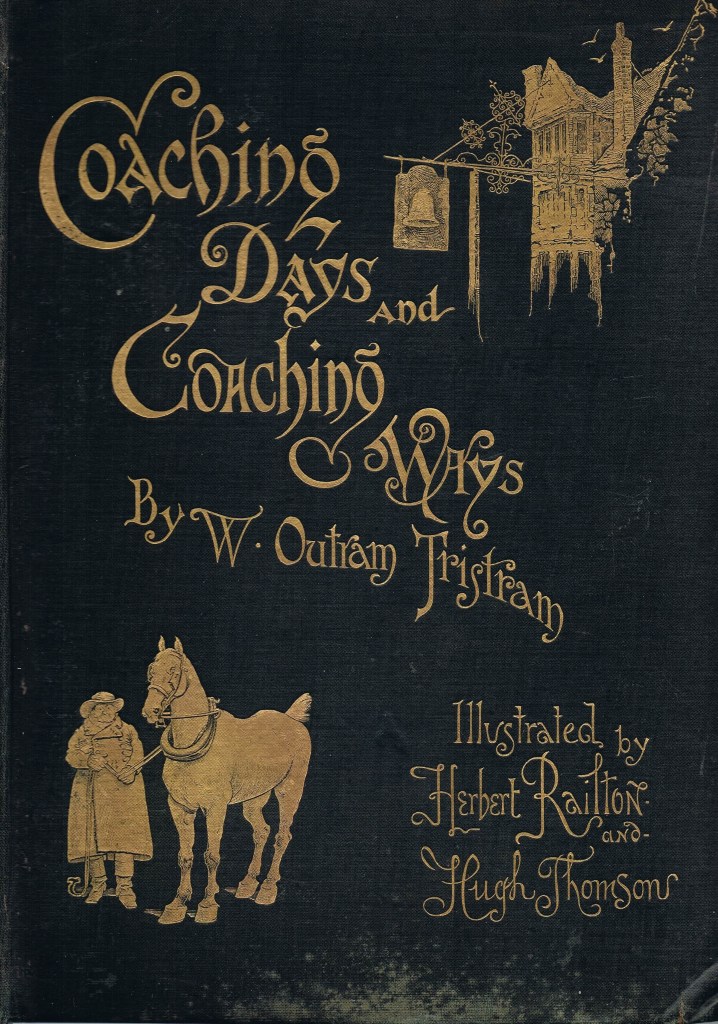
I am sure that everyone who is interested in pub history and the coaching era, have at some stage, either come across during research or have purchased W. Outram Tristram’s Coaching Days and Coaching Ways from a secondhand or antiquarian bookshop to add to their collection. Glance along your bookshelves or down those piles of books on the floor and it will be there. I guarantee it.
My first meeting with W. Outram Tristram’s most well-known tome was when I purchased the 1903 MacMillan Illustrated Pocket Classic printing for little cash three decades ago. Then, more recently, I acquired a first edition of Coaching Days and Coaching Ways (see right) in Norwich for £35.
William Outram Tristram (1859–1915) was born in 1859 in Bombay, India, the son of William Barrington Tristram (1824–1877). He attended Winchester and Merton College, Oxford, but did not take a degree. He turned to writing as a career, producing novels, for example, Julian Trevor (1883), plays such as The Red Lamp, and non-fiction including Coaching Days and Coaching Ways (1888). In 1880, he married Nina Mildred Brown, the daughter of Major David Philip Brown of the 7th Hussars. He died in 1915. Despite an extensive search of the ‘net, I have been unable to find a portrait of the author.
Tristram’s tome is extremely well-written and with excellent illustrations by Hugh Thomson (b. 1860) and Herbert Railton (b. 1857), many, including me, hold it in high regard. Indeed, Pub History Society member Barrie Clark, like many others, ranks Coaching Days and Coaching Ways as one of his favourite top ten pub-related books in 2020, he was not alone. He told me, “I thrive on coaching tales and inns.” (So do I.)
I have not written about Coaching Days and Coaching Ways in the past because it was/is so familiar that I would surely be preaching to the converted. So why now?
The reason is simple.
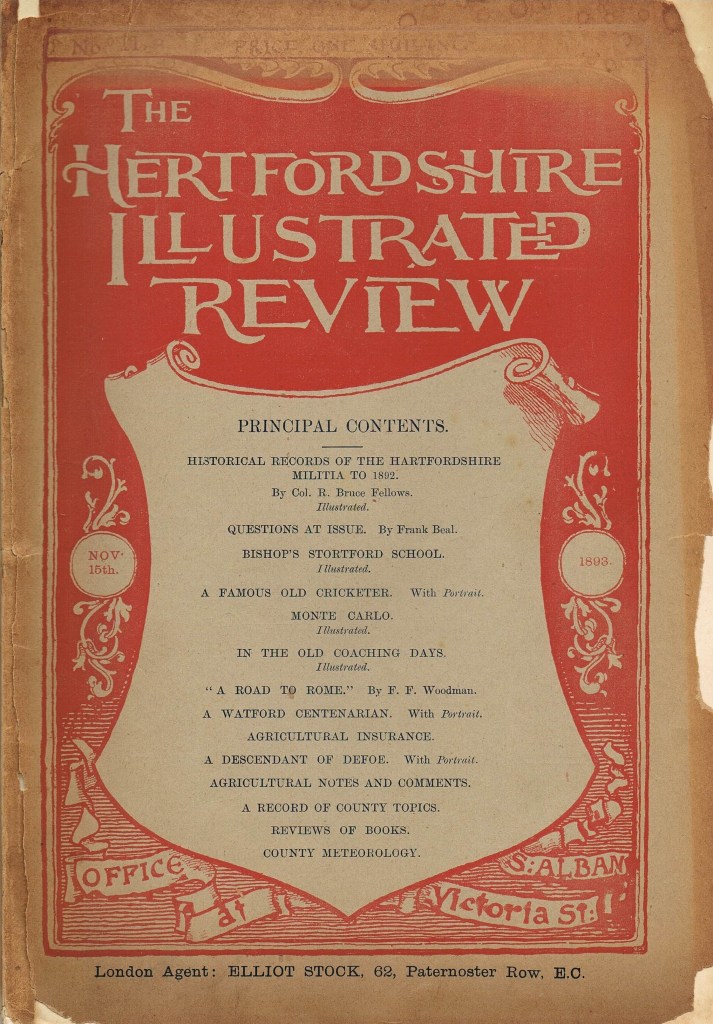
In Suffolk in 2023, I discovered a ten-page review of Coaching Days and Coaching Ways in the 15th November 1893 issue of The Hertfordshire Illustrated Review (left); a magazine ‘conducted and edited by Fred. G. Kitton.’ The article is titled ‘In the Old Coaching Days’ was written by ‘F. G. K.’
Kitton’s review commences
‘There are many persons now living who can distinctly recall the good old days of Coaching, and who therefore remember the revolution in public travelling brought about by the introduction of railways. Although our present system is immeasurably superior in point of comfort, it cannot, I think, be denied that there was much more romance connected with Coaching than is experienced to-day on the “iron road,” when journeys were generally, relieved not only by the ordinary incidents of changing horses, varying scenes, refreshment at the different stopping-places, and all the attending excitement, but by less welcome adventures in the form of importunate highwaymen and those multitudinous accidents to the coach itself…
As compared with Coaching, it must be admitted that Railway days and Railway ways do not afford much scope for romantic writing…

Kitton naturally quotes extensively from Tristram’s text while the illustrations by Thomson and Railton illuminate his review as easily as they did in the original book and, not surprisingly, Kitton eventually focused on the Holyhead Road because
‘I venture to conclude this notice of a really entertaining volume with references to, and quotations from, his concluding chapter dealing with the Holyhead Road, as it runs through Hertfordshire, should appropriately find a place in this Review.’
Having spoilt his readers with many interesting facts, amusing incidents, and anecdotes from Tristram’s text, Kitton decided that he must refrain from further quotes from
‘…this tempting volume so consummately prepared by Mr. Tristram and his artist collaborators, and so luxuriously produced by the enterprising publishers, [my readers] will assuredly endeavour to procure copies for themselves.’
Praise indeed but wait…
‘Speaking critically, however, I venture to point out one or two slight errors which might be corrected in a future edition.’
Kitton then refers to
‘The engraving on page 351 of the volume before me [but on page 345 in the First Edition beside me] is misleading when entitled the “George and Red Lion,” for the first-named Inn cannot be seen from this point; the old gabled houses in the centre of the picture is [sic] the business-establishment of Messrs. Wiles and Lewis, oil and colour merchants, and has nothing to do with the “George,” which adjoins it on the further side.’

This would explain why Kitton amended the original caption ‘The George and Red Lion, St. Albans’ in Tristram’s book when he published the illustration as part of his review to ‘A Sketch in High Street, St. Albans.’ But he’s not finished…
‘The signboard, too, [left] represented as projecting from a house on the right is, I presume, an artistic license, as it never existed; while the name depicted thereon should be the “Great (not the “Old”) Red Lion.”
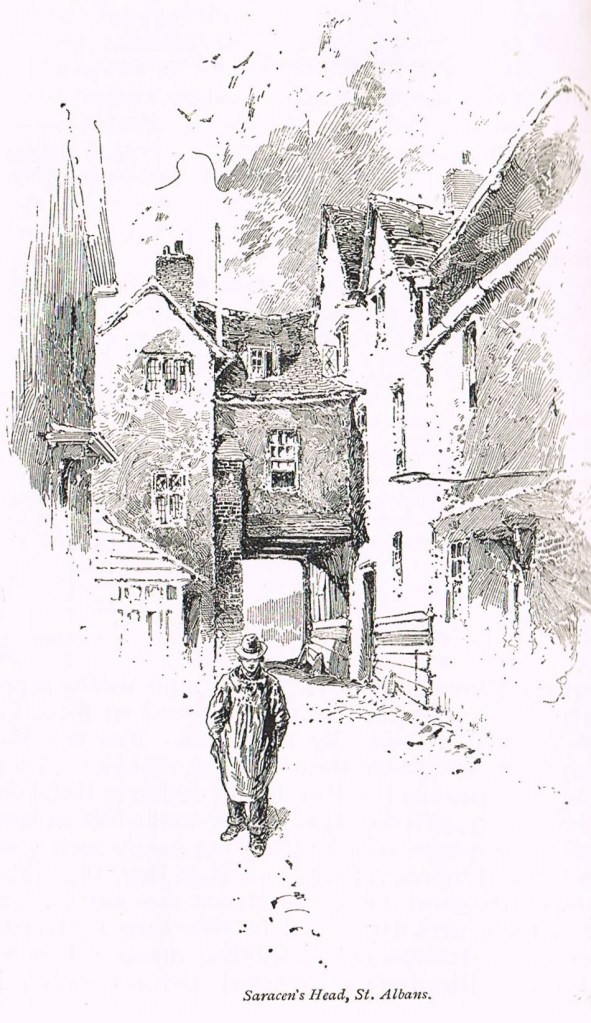
The other mistake to which I allude is that to be found under the illustration [right] on page 346 [page 340 in the first edition]; it is designated the “Saracen’s Head,” whilst it really depicts the yard of the adjoining Inn, viz, the “White Hart” – a much more important hostelry.
It was the “White Hart” where Hogarth painted from the life his well-known portrait of Simon Lord Lovat, who stayed there when on his way to the Tower to be executed.’
Here Kitton’s review ceased abruptly, I thought, but I had to research further as (regrettably) the name Simon Lord Lovat meant nothing to me.

However, this was soon remedied, with reference to the Royal Academy, where I found the aforesaid ‘well-known portrait’ of Lovat (left) and the following illuminating text:
Portrait of Simon Fraser, eleventh Lord Lovat, Jacobite conspirator, sat at a desk on which rest his ‘Memoirs’. After his arrest in 1746 [after the 1745 rebellion] Lovat was brought to London for trial.
On the way he stopped briefly in St Albans, where William Hogarth arranged to meet him at the White Hart Inn and to interview and draw him. The result of the meeting was this famous print, published while Lovat was lodged in the Tower of London. The print was much in demand and was the source of numerous contemporary copies. On 9 April 1747 he became the last man in England to be beheaded. The crowd for Lovat’s execution was huge…
Kitton’s ‘corrections’ made me wonder if (a) the publisher ever picked up his comments and (b) if they did, was the text revised at any time?
Also, if Kitton was to find so many errors in only two illustrations presented by Thomson/Railton and the associated text only about St. Albans, how many other errors of fact, written and/or drawn, must have been discovered by other reviewers over the years which had been formally noted but had gone unchallenged and thus not corrected. The most recent of Coaching Days & Coaching Ways that I have in my archive was published in 1985 by Bracken Books in which the ‘errors’ identified 100 years ago remain unchanged.
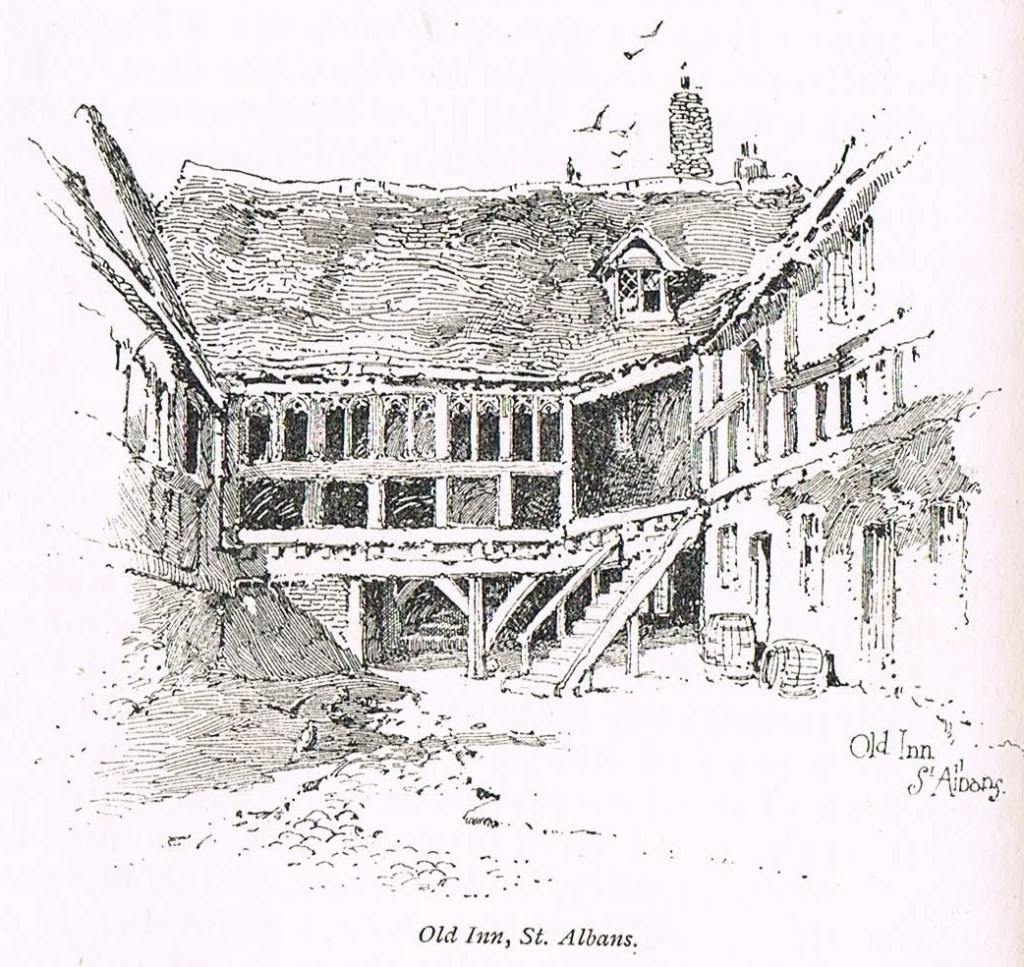
What disappoints me more about Kitton’s ‘errors’ is that he did not pick up on the unidentified ‘Old inn, St. Albans,’ illustrated on page 354 (my page 347) which, irritatingly, he overlooked and thus failed to identify for us. I publish the illustration (below) in the hope that any reader, who majors in St. Albans, can help me. If so, please contact me via this website.
For an appropriate closing line, I quote from Dave Walker’s article which I found at The Library Time Machine, 17th August 2017, in which, after referring to the works of Thomson and Railton in Coaching Days and Coaching Ways he observed that
‘the Victorians and the Edwardians were just as nostalgic for the colourful past as we are today.’
Fair enough. I think.
Patrick Chaplin
Sources:
Clark, Barrie. ‘Extra Chair’ in Pub History Autumn 2020.
Johnson, W. Branch, Hertfordshire Inns – A Handbook of Old Hertfordshire Inns and Beerhouses – Part Two – West Herts. (Letchworth: Hertfordshire Countryside, 1963.)
Jolliffe, Graham & Jones, Arthur. Hertfordshire Inns & Public Houses – an historic gazetteer. (Hatfield: Hertfordshire Publications, 1995.).
Kitton, Fred. G. Article ‘In the Old Coaching Days’ in The Hertfordshire Illustrated Review, Number 11, November 1893, pp. 692-702.
Tristram, William Outram. Coaching Days and Coaching Ways (London: Macmillan and Co., 1888 and Second Edition (June 1893), reprint 1894, Macmillan’s Illustrated Pocket Classic, 1903, and Bracken Books, London, 1985).
Websites:
Bassett, Troy J. “Author: William Outram Tristram.” At the Circulating Library: A Database of Victorian Fiction, 1837—1901, 15 May 2023, http://www.victorianresearch.org/atcl/show_author.php?aid=736. Accessed 21 May 2023.
Simon Lord Lovat – Royal Academy https://www.royalacademy.org.uk/art-artists/work-of-art/simon-lord-lovat-1
Walker, Dave. The Library Time Machine, article dated 17th August 2017:
https://rbkclocalstudies.wordpress.com/tag/w-outram-tristram/
With thanks to Chris Murray.
Original text © 2023 Dr. Patrick Chaplin
[This article was first published in Pub History, the quarterly journal of the Pub History Society, the Autumn 2023 issue.]
 Dr Patrick Chaplin
Great article Patrick although I had a quiet chuckle when I seen the photo of Simon Fraser (Lord Lovat) I thought he looked like Benny Hill
LikeLiked by 1 person