THE NATIONAL DARTS ASSOCIATION (NDA) – PART ONE
‘When the [National Darts] Association was formed…there were only eight [darts] leagues in existence…now there are nearly 200 affiliated to the N.D.A… More than a quarter of a million players are registered with the N.D.A. and the number playing the game ‘unofficially’ must run into millions.’ [Charles W. Garner, ‘DARTS: from village inn to Mayfair,’ Radio Times, 18 June 1937.]
Many darts fans might think that the formal organisation of darts began with the BDO (British Darts Organisation) in 1973. That was certainly when the game received an amazing jab in the arm which led to the second ‘boom’ of darts in the 20th Century.
Thinking even further back, older darts players may remember the formation of the National Darts Association of Great Britain (NDAGB) which grabbed hold of the loose reigns of darts organisation in 1954 and lasted until being trampled underfoot by the BDO juggernaut in the early 1980s.
But no. The organisation of darts began in 1924 and it was in 1925 that the National Darts Association (NDA) was formalised.
On Thursday 12 February 1925 a group of professional men met in the offices of the Morning Advertiser in London to discuss the establishment of an English darts association for the control of the game of darts and for unifying the rules. Thus, it might be imagined that their motives were similar to those of other members of the elite who, during the innovative and expanding world of mid-Victorian leisure, had met to organise and codify athletic sports, mainly track and field, to reconstruct football and to reform cricket: their primary aim through rational recreation being to ‘forge more effective behavioural constraints’ in leisure.
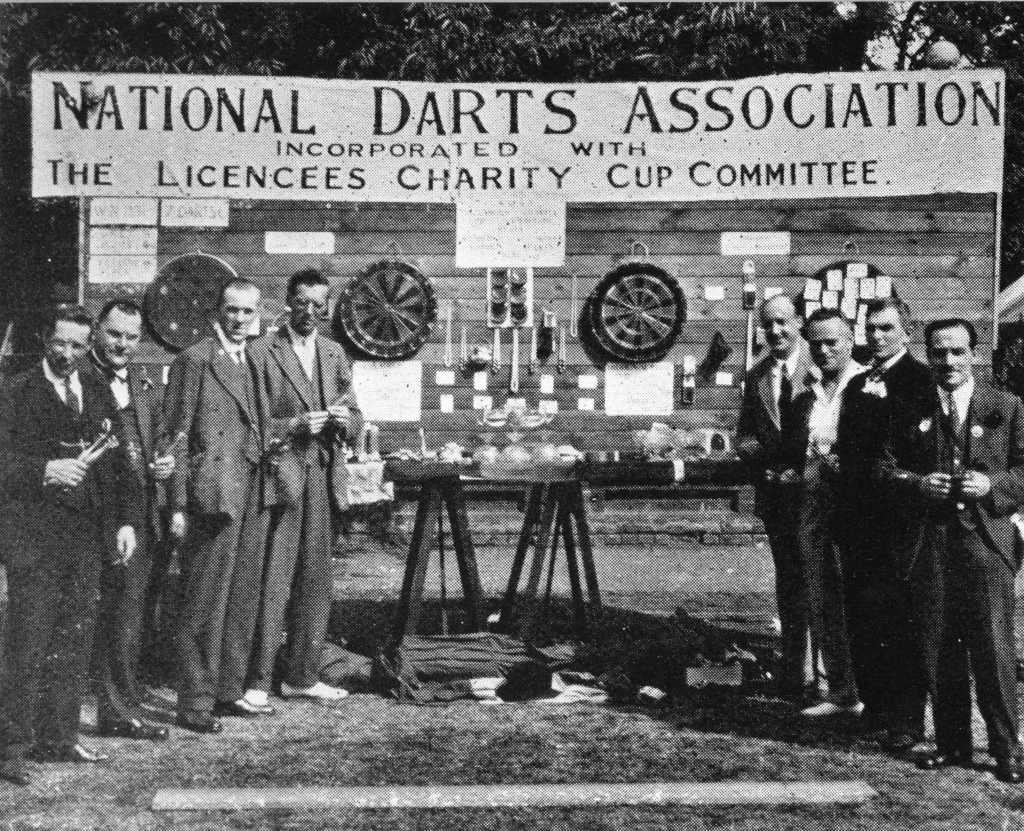
(The line-up of NDA committee members and the Licencees Charity Cup Committee shown above, in 1927 includes Charles W. Garner, Hon. Sec. of the NDA, second from the left and Ted Leggatt, founder of the NODOR Dartboard Co., is shown, darts in hand, fourth from the left, with other members of the NDA and the Executive Committee.) (Image © NODOR. Used with permission.)
The NDA was a more complex organisation although it fulfilled the requirement of codification that accompanied all major sports, games, and pastimes. The rules and principles laid down by the NDA in 1925 remain at the very heart of darts across the world today. The NDA needs to be seen in the context of a wider associational culture that had shaped leisure for more than one hundred years previously.
In addition to the aims of controlling darts and bringing respectability to the game, the threat from alternative leisure forms was to be a prime motive for the establishment of the National Darts Association.
Whilst the fundamental principle of control was inherent in the rules of the NDA, the Association was more concerned with protecting the game from external influences who might utilise darts for illegal gain, thus bringing respectability to darts especially in the context of the improvement of English public houses, than directly promoting darts as a developing sport to compete against, say, football or cricket.
By the early 1920s darts was already largely the working-class pastime and thus any thought of social exclusion was meaningless.
The NDA’s motives were to consolidate darts as a popular recreation in public houses as a counter attraction to alternative leisure options including not only other sports but also the cinema and dance halls. The NDA played a pivotal role in the development and expansion of the game of darts as an organised recreation in public houses during the interwar years.
Whilst the brewers provided the premises and financial backing in the form of provision of equipment and prizes, the NDA was responsible for the application of rules and the popularisation of darts in pubs across the country. Ironically, during the mid-to-late 1930s, the NDA managed to achieve social inclusion as darts found favour with the middle and upper classes as a popular form of novelty recreation.
Also, the NDA engaged in close working relationships with the News of the World, the first national Sunday newspaper to sponsor darts.
Until the 1920s, darts had been developing in English public houses in an ad hoc way with different styles, sizes, and designs of dartboards, differing rules of play and with relatively low levels of participation. However, during the interwar period, the game was transformed by the NDA into one of the most popular participative recreations in England. Until then darts was one of many pleasant, participative diversions for the working class – both team and individual – to be found in some, but by no means all, English public houses.
Depending on the locality in which it was played, darts received little or no attention or support from brewers. However, during the early 1920s, darts playing became increasingly popular and forces came into play that would revolutionise darts’ role in English, rather than British, society thus enabling it to evolve into a key element of mass leisure in parallel to, and in competition with, other forms, including the cinema,in the country during the interwar years.
It would be easy to state that the NDA was an association born of the licensed trade which simply imposed rules on the working-class pub-goer, but the situation is in fact much more complex. In essence, the formation of the NDA was a response to both the demands from licensees for regularisation of the game and from the brewers who, as part of their on-going schemes of public house improvement during this period, had begun to recognise the true value to their customers of indoor recreations, which included darts.
The first evidence of substantial and sustained demand for standard rules for the game of darts first appears in the early part of 1924 in the Morning Advertiser, the newspaper for the licensed trade which mainly circulated inthe south-east of England.
By the beginning of 1924 the newspaper had begun to feature reports on darts leagues, matches, and competitions on a regular basis. Between February and March reports were published in relation to the South West Ham, Southend, Woolwich, Surbiton, Little and Long Ditton, Southwark, North Woolwich, Pinner and district dart leagues, the Castle Surbiton Hill Dart Club, and the Isleworth Brewery Darts competition. This was a volume of darts reporting previously unknown in the Morning Advertiser or any other publication.
Such was the demand for news and advice that by September 1924 the Morning Advertiser had its own – and the first ever – darts columnist – John A. Peel. Peel was a journalist from Surbiton, Surrey and a keen exponent of darts who played in and was Honorary Secretary of the Surbiton and the Dittons Darts League.
Licensees responding to the increasing demand for darts in their public houses sought advice and guidance from the Morning Advertiser. In return, Peel proffered the benefit of his experience in organising darts leagues to interested parties whilst accepting that, given there were different leagues extant which had their own systems of play, there were no general rules that he was aware of in existence.
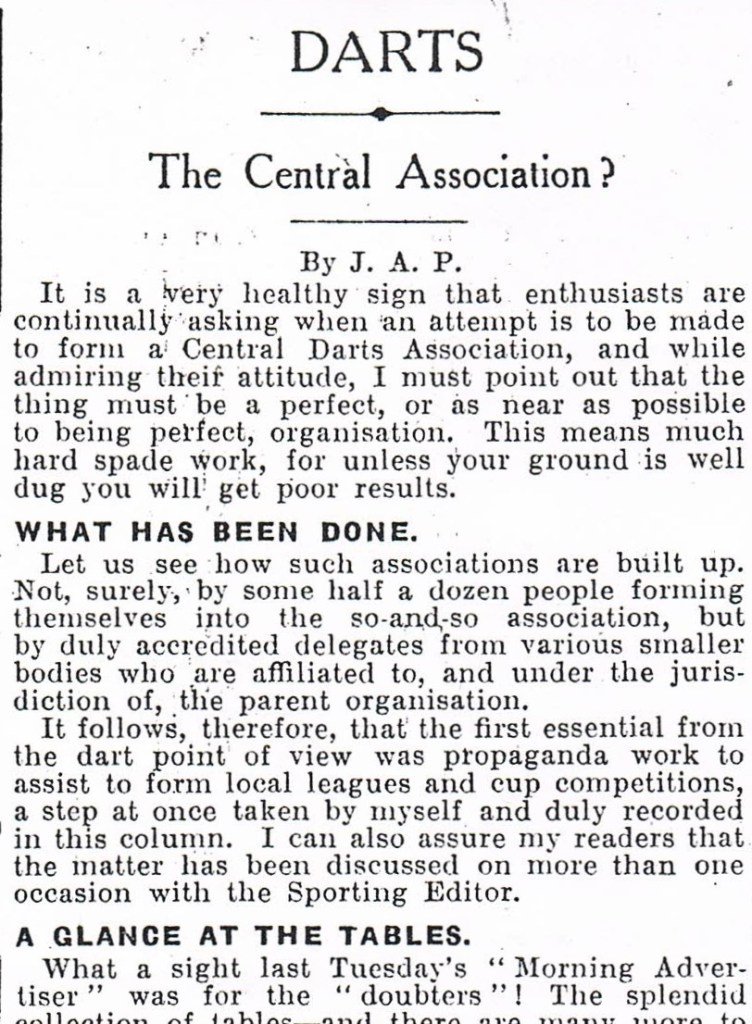
Enquiries about standard rules of the game increased substantially between September and December 1924 and it was towards the end of this period that a ‘Central Darts Association’ was mooted for the first time. Through the Morning Advertiser Peel called for delegates to attend an exploratory meeting. Actively inviting dart club secretaries to participate in the decision-making process and, eventually, to take seats on the executive committee of the formative Association was a ground-breaking idea in terms of organised sport.
Despite his experience of darts, Peel was of the view that the construction of the rules of darts was best dealt with by consulting with those at grass roots level rather than regulations being drawn up by an elite group and then imposed upon association members. The theme that emerges from Peel’s proposal is that there was a relatively democratic grass roots pattern to darts; no sense of a specific desire on the part of the brewers or licensees to control darts players, but more of a sense of inclusion; a decision that doubtless shaped the character of this developing pub game, although the democratic process was not quite as inclusive as first thought. (The report featured left, is from the Morning Advertiser dated 30th December 1924.)
The establishment of the first national darts organisation
By the beginning of 1925 the men and the skills needed to establish a ‘Central Darts Association’ had been identified and league secretaries were asked to notify Peel of their willingness to attend a preliminary, exploratory meeting in London.
By February 1925 Peel was convinced that time was of the essence and that it was important to bring the association into being sooner rather than later. He wrote
‘I am not without knowledge of the possibility of others, chiefly for commercial gain, attempting to reap the benefit of the splendid work of the various leagues and to foist their views and rules on the dart-playing public …’
It is unlikely that the Morning Advertiser would have embarked on a campaign to establish an association, or would have reacted so quickly and so positively to the requests for standardisation of darts and affording darts valuable column inches, unless there were some significant benefits to be derived to both the brewers and the licensed trade.
Peel had recognised a number of warning signs and decided that it was an appropriate time to establish a central darts association and for it to be introduced sooner rather than later before one of the ‘others’ stole the initiative. Although the ‘others’ are not defined it is possible that Peel was referring to links with organised gambling or more likely the News of the World which, less than a year later would be working with what would become known as the National Darts Association (NDA) on the first major London-based, sponsored darts competition.
In February 1925 a scheme to launch the Central Darts Association was announced; the main principle being the ‘government of darts by the selected representatives of properly constituted leagues.’ Honorary league secretaries were invited to nominate two delegates to attend a meeting to be held at the office of the Morning Advertiser at 127 Fleet Street, London E.C.4, at 7.30 p.m. on Thursday, 12 February 1925. The members of the licensed trade were better placed to implement and control the game of darts locally whilst the brewers were a formidable, powerful lobby. Thus, with the brewers’ backing, the NDA would be able to resist any attempt from forces outside of the licensed trade to control darts.
However, there was more to setting up the Association than simply appointing and encouraging a team of experienced organisers.
At the February meeting all twenty-four delegates, all darts league representatives and in all probability were either darts club secretaries or licensees; in other words, people either working at grass roots level, playing in or organising darts leagues, or representing the interests of specific brewers.
It is likely that their motivation for being there was not restricted to a general interest in promoting the game of darts per se; more likely to hear how best to organise a game that would bring more people through the pub doors as all around alternative leisure options were affecting the pub trade.
(TO BE CONTINUED)
(c) 2025 Patrick Chaplin.
 Dr Patrick Chaplin