While broadcasters clamour for a piece of the darts cake, I bring you a special report highlighting when the BBC (Britain’s national broadcaster), which has had little or no involvement with darts for some time, confirmed that the company had “No Plans” to be involved with the sport in the future.
Regular readers of my free, Monthly, global, newsletter, Darts History, and those visiting my website, will know that I have often written about darts on television and those who know of the contents of my book Darts in England 1900-39 – A social history (still available in paperback) will recall that darts was first broadcast by the BBC from the Alexander Palace, on ‘London Television’ at 9.25 p.m. on Saturday 29 May 1937; a programme titled ‘Darts and Shove Ha’penny.’

[Sadly, I have no photos from that historic day but reproduce here an image (above) which shows the filming of a darts match by the BBC at the Alexandra Palace in 1949 where conditions a decade or more on would not have changed that much. Image © Patrick Chaplin/The Dart. Used with permission.]
Here is the earlier BBC report in full:
‘Since the Boon v Danahar* contest was televised with such tremendous success two weeks ago we have been reading in the public Press just how new scientific is going to revolutionise all sporting broadcasts. So perturbed was the British Boxing Board of Control in the matter that you will have noticed that it determined to keep boxing from a possible box-office evil by banning all television broadcasts without the express permission of the Board of Control.
[* Eric Boon and Arthur Danaher were involved in the first-ever televised boxing match, broadcast by the BBC in 1939. Boon, a British lightweight boxer, defeated Danaher in this historic fight, which was also shown live in cinemas. The match was a significant event, marking the first time a boxing match was televised and simultaneously shown to a paying audience in theatres. This was two years after darts first appeared on TV.]
Somewhat Perturbed
Apart from the fact that John Harding defied this ban at the N.S.C. show at Earl’s Court on Monday night, and that all sports promoters must necessarily feel somewhat perturbed about television as a possible box-office enemy, the prospect of television affecting all sporting events must seriously be considered.
With this idea in my mind, I was naturally interested in the plans of the B.B.C. regarding television broadcasts of darts matches. I thought that the B.B.C. would naturally have some plans in regard to such a popular game as darts, and so I got in touch with the Press Department at Alexandra Palace.
Nothing Fixed!
And what do you think I found? Only that until April there is nothing fixed for darts at all, and, apparently, the programme from April on are not fixed!
When I enquired about television broadcasts of darts at the beginning of the season I was told that the game would be on air once a month according to the plans at that time, and so I can only say what a pity it is that darts, the most popular game in the country today, is, apparently not being considered by the television powers that be!
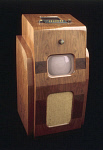
[Image, above, is of a combined television and radio dated 1938. © Science & Society Picture Library.]
It may interest readers to know that some eighteen months ago I put up the suggestion that a television demonstration might be featured of the various styles of dart-playing now in practice throughout the country. The suggestion was duly acknowledged and something, it was hoped, would be done about it.
Here we are, nearly two years later, and the suggestion has been tactfully ignored. I thought in my naïve manner, that this would have been of interest to “viewers.” Of course, with all the blah which has appeared in the dailies about television the number of people actually possessing sets cannot have been very large.
Popular Levels
But I saw a television set made by a reputable firm the other day priced at 30 guineas, which seems to suggest that the manufacture of such sets is now reaching popular levels.
When the price of these sets has reached reasonable levels then a large increase in “viewers” can confidently be expected, and then darts will become an essential part of the programmes.
That is, unless the attraction of chamber music and the highbrow items is considered by Mr. Gerald Cock and his assistants to be of infinitely more entertainment value!’
*******************************
The author of above report, extracted from Darts & Sports Review dated 11th March 1939, was not only concerned about the apparent proposed lack of televising of darts but also the fear that television would effectively remove the public from being spectators to events such as boxing, and presumably, horse racing and football, encouraging people to become viewers of sport on TV at home rather than spectators at the events. But the reporter was projecting his fears into the future. The number of people, and therefore ‘viewers,’ were few at that time and restricted to only those who could afford a ‘set.’
But, of course, nobody could honestly predict at that time just how much the ‘miracle’ of television would eventually devour so much of everyone’s time yet fail to dent the people’s love of genuine, ‘live’ sport.
By September 1939 though, all thoughts turned to something else.
© Patrick Chaplin. 14th October 2025
[First published in Darts History #185, August 2025. Reproduced with permission. To subscribe to my free, monthly,global Darts History newsletter, please contact me via the Contact page.]
 Dr Patrick Chaplin